Understand business needs objectives
Propose tech stack, timelines architecture
Sprint-based development with regular demos
Final testing and go-live with complete documentation
Ongoing maintenance, upgrades scale-up
Understand business needs objectives
Propose tech stack, timelines architecture
Sprint-based development with regular demos
Final testing and go-live with complete documentation
Ongoing maintenance, upgrades scale-up

We help define the ideal stack
Our architects suggest best options
With estimation, milestones & approach
Flexible delivery model: fixed or dedicated

Get expert tech consultation at no cost.
Get Free Tech AdviceBrief us on your needs (tech stack, duration, etc.)
Receive matched profiles within 24–48 hours
Interview the candidates and choose the right fit
Kick off the project seamlessly with our support

Cloud Architecture
We help businesses build secure, scalable, and high-performance cloud infrastructure. Our architectures are flexible, reliable, and cost-optimized — designed to grow with your product and keep operations future-ready.
Best for organizations already invested in the Microsoft ecosystem, offering seamless hybrid cloud and enterprise-grade integrations.
DevOps Automation
Our DevOps practices accelerate software delivery, improve collaboration between development and operations, automate deployments, and enhance system reliability while reducing operational overhead.
Automates container orchestration at scale, enabling resilient, self-healing infrastructure for demanding workloads.
Defines infrastructure as code, making environments reproducible, auditable, and easy to scale across teams.
Powers high-performance load balancing, reverse proxying, and secure traffic routing for modern applications.
Infrastructure Security
We safeguard cloud infrastructure and applications through proactive security practices, continuous monitoring, risk mitigation, and business continuity planning — so your team can operate with confidence.
Ensures critical data is regularly copied and recoverable, minimizing the risk of permanent loss or corruption.
Prepares your systems to recover quickly from failures, keeping downtime and data loss to an absolute minimum.
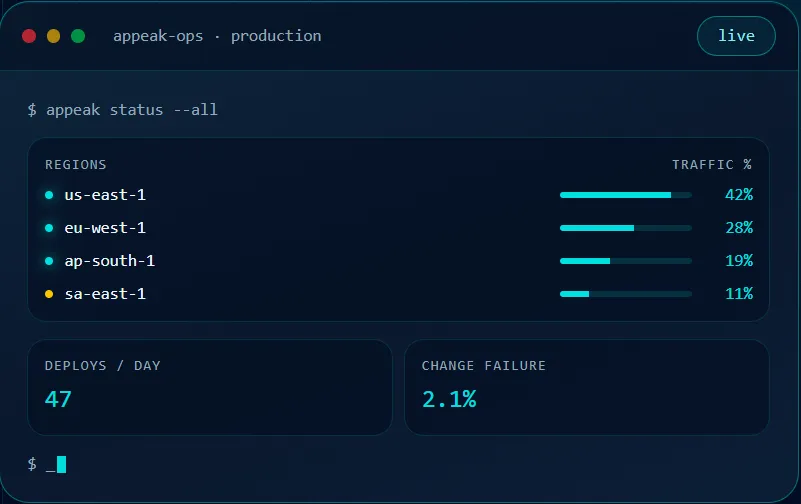
Cloud Operations
We streamline software releases through automated deployment pipelines, scalable infrastructure, and performance optimization — enabling faster, more reliable product delivery with every commit.
Trunk protected. Conventional commits.
Parallelized, cached, <8 min.
SAST, SCA, IaC, secrets.
Canary → 10% → 100%.
Auto rollback on burn-rate.
Every resource is defined in code, versioned in git, and reviewed like application code. We standardise on remote state with locking and module libraries for common patterns.
Production-grade K8s (EKS/GKE/AKS) with GitOps. We build the ‘golden path’ so developers can ship faster without worrying about the underlying cluster configuration.
Standardizing the environment from local dev to production. We optimize Dockerfiles for security, size, and build speed, ensuring consistent behavior across all stages.
One workflow language for build, test, scan, and deploy. Reusable workflows keep app teams from re-inventing pipelines and gate production behind approvals.
Battle-tested edge for TLS termination, rate limiting, and traffic shaping. Deployed as ingress in K8s or standalone tier when clusters aren’t needed.
Not everything needs K8s. For small fleets, Swarm gives 80% of the value at 20% of the complexity — using the same Compose files you already have.
Controls are baked into the infrastructure, so the auditor gets logs, not slide decks. A two-quarter SOC 2 becomes a six-week SOC 2.
Monitoring & Logging
Real-time observability, SIEM, audit trails
Backup & Restore
Point-in-time recovery, cross-region replication
Disaster Recovery
RTO/RPO targets, automated failover drills
SOC 2 / ISO 27001
Controls, evidence, auditor liaison
PHI segmentation, tokenization, audit logs
GDPR / DPDP
Data residency, DPIAs, subject requests
Median rolling 12-month across managed clusters.
Compute capacity scales horizontally with real-time traffic demand.
Tuned latency and throughput for high-performance workloads.
We implement automated, cross-region backups and point-in-time recovery for all databases. Disaster recovery plans are codified and tested quarterly through automated failover drills to ensure RTO/RPO targets are met.
Yes. We use a combination of horizontal pod autoscaling (HPA) in Kubernetes and cloud-native auto-scaling groups, triggered by CPU, memory, or custom metrics like request queue depth.
Single-cloud by default — it’s cheaper and simpler. We go multi-cloud only when data residency, vendor risk, or a specific service actually justifies the operational tax.
FinOps tagging, weekly cost reports, and unit-economics dashboards tied to product metrics. If a feature gets 3× more expensive per user, you’ll see it before finance does.
Book a free 45-minute architecture review. Walk away with a diagram, a cost estimate, and an honest verdict — even if it’s “leave it alone.“