Understand business needs objectives
Propose tech stack, timelines architecture
Sprint-based development with regular demos
Final testing and go-live with complete documentation
Ongoing maintenance, upgrades scale-up
Understand business needs objectives
Propose tech stack, timelines architecture
Sprint-based development with regular demos
Final testing and go-live with complete documentation
Ongoing maintenance, upgrades scale-up

We help define the ideal stack
Our architects suggest best options
With estimation, milestones & approach
Flexible delivery model: fixed or dedicated

Get expert tech consultation at no cost.
Get Free Tech AdviceBrief us on your needs (tech stack, duration, etc.)
Receive matched profiles within 24–48 hours
Interview the candidates and choose the right fit
Kick off the project seamlessly with our support

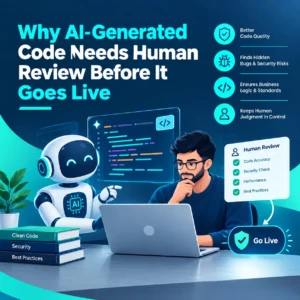
Artificial intelligence is changing how software is developed. Modern AI coding assistants can generate functions, suggest fixes, explain unfamiliar code, and help developers complete repetitive programming tasks in less time. These capabilities can improve productivity, but faster development does not automatically mean better software.
Before AI-generated code becomes part of a live website, mobile application, or business platform, it needs careful human review. Even when code looks correct, it may contain hidden errors, security weaknesses, performance issues, or logic that does not match the project’s actual requirements.
Understanding why human oversight matters can help businesses use AI effectively without compromising software quality.
AI coding tools generate suggestions based on patterns learned from existing code and the context provided to them. They can produce useful solutions, but they do not guarantee that every suggestion is accurate or suitable for a particular application.
For example, an AI assistant might generate a database query that works with sample data but fails when the application processes thousands of records. Similarly, a function may handle a normal user request correctly while producing unexpected results when required information is missing.
Human developers examine these situations before deployment. They check the logic, validate assumptions, test unusual scenarios, and confirm that the implementation meets the original requirements.
A program can function as expected while still exposing sensitive information or allowing unauthorized access. This makes security review particularly important when AI tools generate authentication logic, API endpoints, database queries, or payment-related functionality.
Potential issues include weak access controls, unsafe handling of user input, exposed API keys, and incorrect permission checks. AI-generated code may also introduce dependencies or implementation patterns that require closer inspection.
Developers should review authentication, authorization, input validation, error handling, and data protection before releasing new functionality. Automated security tools can support this process, but qualified human reviewers remain important for understanding how different components interact.
For applications handling financial, customer, or business information, these checks are essential to maintaining trust.
Every software project has its own architecture, naming conventions, coding standards, and business rules. Code that works independently may not fit naturally into the existing system.
For instance, a Laravel application may follow specific patterns for controllers, services, validation, database relationships, and automated tests. If an AI assistant does not understand these conventions, it may create unnecessary classes, duplicate existing functionality, or introduce inconsistent logic.
Developers must therefore evaluate whether generated code follows the project’s established structure. Appeak Technologies discusses a related approach in its guide on creating AI coding rules from an existing codebase. Defining project-specific rules helps AI tools produce suggestions that better match the application’s architecture.
AI-generated code may solve an immediate problem without considering what happens when an application grows. Inefficient database queries, unnecessary processing, repeated API calls, and excessive resource consumption can affect application speed and operating costs.
A developer can identify these issues by reviewing query patterns, measuring response times, inspecting resource usage, and testing realistic traffic conditions.
This is especially important for SaaS platforms, e-commerce websites, and enterprise applications where a small inefficiency can become significant as user activity increases.
The objective is not simply to make the code run. It is to ensure that the solution remains maintainable, responsive, and practical as business requirements evolve.
AI tools can interpret instructions, but incomplete prompts may lead to incomplete implementations. A feature might work technically while missing an important business rule.
Consider an online store that needs to calculate discounts. Generated code might apply a percentage discount correctly but overlook product exclusions, minimum purchase amounts, customer eligibility, or regional tax requirements.
Human reviewers can compare the implementation against the approved specifications and clarify missing details with stakeholders. This step ensures that the final feature solves the intended business problem rather than merely satisfying a programming request.
Businesses do not need to avoid AI coding tools to maintain quality. Instead, they can establish a clear review process before deploying generated code.
A reliable workflow includes these steps:
This approach combines the speed of AI-assisted development with the accountability of professional software engineering.
AI-generated code can help development teams move faster, reduce repetitive work, and explore implementation options. However, speed alone cannot guarantee secure, reliable, or scalable software.
Human review remains essential for validating logic, identifying vulnerabilities, checking architectural compatibility, testing performance, and confirming business requirements. When developers combine AI assistance with structured testing and responsible deployment practices, they can gain productivity without treating generated code as automatically production-ready.
At Appeak Technologies, the goal of AI-assisted engineering should be to build practical software that meets real business needs. The strongest results come from combining modern AI capabilities with experienced developers, sound engineering decisions, and continuous quality checks.