Understand business needs objectives
Propose tech stack, timelines architecture
Sprint-based development with regular demos
Final testing and go-live with complete documentation
Ongoing maintenance, upgrades scale-up
Understand business needs objectives
Propose tech stack, timelines architecture
Sprint-based development with regular demos
Final testing and go-live with complete documentation
Ongoing maintenance, upgrades scale-up

We help define the ideal stack
Our architects suggest best options
With estimation, milestones & approach
Flexible delivery model: fixed or dedicated

Get expert tech consultation at no cost.
Get Free Tech AdviceBrief us on your needs (tech stack, duration, etc.)
Receive matched profiles within 24–48 hours
Interview the candidates and choose the right fit
Kick off the project seamlessly with our support

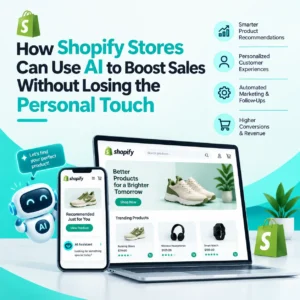
Shoppers today expect speed, relevance, and a little warmth. Shopify merchants, especially small and mid-sized ones, rarely have a large team to deliver all three. Artificial intelligence can close that gap by handling repetitive work and surfacing patterns that are easy to miss, but it can also make a store feel cold if it is used carelessly.
The goal is not to replace the human voice of your brand. It is to give that voice more reach. Here are practical ways to use AI to lift sales while keeping the personal touch that customers remember.
Recommendation tools study browsing and buying behaviour to suggest items a shopper is likely to want. Placed on product pages, in the cart, and in post-purchase emails, they can raise average order value without any pushy selling.
To keep it personal, curate the logic. Pair automated suggestions with hand-picked bundles, seasonal edits, or a short note from the founder. Shoppers can tell when a store simply shows what is popular and when it shows what genuinely fits them.
AI writing tools can draft descriptions for hundreds of products in an afternoon, which is a real saving for large catalogues. The risk is a wall of identical, generic copy that could belong to any brand.
Create a short style guide covering tone, favourite words, and phrases you never use, then feed it into every request. Treat each draft as a starting point, and edit the opening line and the closing detail by hand. Real material facts, such as sizing, care, and sourcing, should always be checked by a person.
A chatbot can answer questions about delivery times, returns, and order status at any hour, which shortens waiting and protects sales that might otherwise be lost overnight. Quick answers are often what turns a hesitant visitor into a buyer.
The personal touch lives in the handover. Make it easy to reach a real person, and pass the full conversation along so customers never repeat themselves. Angry, complex, or high-value queries deserve a human reply. Working with a development partner such as Appeak Technology can help connect these tools to your theme, apps, and store data safely.
AI can group customers by behaviour, predict who is ready to reorder, and choose better send times. A shopper who bought coffee beans five weeks ago is a perfect candidate for a friendly reminder.
Personalisation works best when it feels helpful rather than watchful. Refer to purchases and stated interests, avoid hinting at information the customer never shared, and always offer an easy way to adjust preferences. A message that sounds like a thoughtful shopkeeper will outperform one that sounds like surveillance.
Standard store search often fails when customers type casually, misspell words, or describe a need rather than a product. AI-powered search can interpret phrases like “gift for a new runner” and return relevant results.
Review the questions people search for, since they reveal gaps in your catalogue, naming, and filters. These insights are valuable for merchandising and can inspire new collections, all while making the store feel as though it listens.
Few things damage trust like a popular item selling out right before a festival or a sale. Forecasting tools analyse past orders, seasonality, and trends to suggest how much stock to hold, helping you avoid both empty shelves and dead inventory.
Use the numbers as guidance, not as a command. You know about the influencer collaboration next month or the supplier delay that the data cannot see. Combining human knowledge with machine analysis gives the most reliable plan.
Introduce one AI feature at a time and track its effect on conversion rate, average order value, support response time, and repeat purchases. Read actual customer messages and reviews, not only dashboards, to learn how the changes feel.
Be open about where AI is used when it matters, and protect customer data carefully. Regular reviews ensure that your tools still reflect your values as the store grows, and they give you a clear moment to retire anything that no longer serves your customers. Small, steady improvements usually beat one dramatic overhaul.
AI is most powerful in a Shopify store when it takes over the repetitive tasks and leaves the human moments to you. Faster answers, better recommendations, and smarter stock decisions create room to focus on service, storytelling, and relationships.
If you are planning to add AI features to your Shopify store and want technical help that respects your brand voice, Appeak Technology can help you design and build the right solution step by step.