Understand business needs objectives
Propose tech stack, timelines architecture
Sprint-based development with regular demos
Final testing and go-live with complete documentation
Ongoing maintenance, upgrades scale-up
Understand business needs objectives
Propose tech stack, timelines architecture
Sprint-based development with regular demos
Final testing and go-live with complete documentation
Ongoing maintenance, upgrades scale-up

We help define the ideal stack
Our architects suggest best options
With estimation, milestones & approach
Flexible delivery model: fixed or dedicated

Get expert tech consultation at no cost.
Get Free Tech AdviceBrief us on your needs (tech stack, duration, etc.)
Receive matched profiles within 24–48 hours
Interview the candidates and choose the right fit
Kick off the project seamlessly with our support

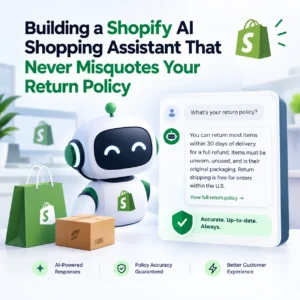
A customer asks your chat assistant whether they can return a sale item after 45 days. The bot replies, “Yes, all items can be returned within 60 days.” Your real policy allows 30 days and excludes final sale products. Now you have an unhappy shopper, a support ticket, and possibly a refund you never meant to give.
This is the biggest risk of adding AI to a Shopify storefront. An assistant that answers questions at any hour is only useful if the answers are correct. Here is how to build one that stays faithful to your policy.
Language models write fluent text based on patterns, not on your store’s rulebook. When the assistant doesn’t have your exact policy text, it fills the gap with what return policies usually say across the internet. This happens for a few common reasons:
Return rules are full of conditions such as time windows, item condition, exclusions and shipping costs. Dropping one condition can reverse the whole answer.
The most reliable approach is retrieval-based answering. Instead of letting the model recall policy details from training, your system fetches the relevant policy section when the question arrives and gives it to the model as the only material it may use.
A practical setup looks like this:
This way the assistant never serves stale rules.
The most reliable approach is retrieval-based answering. Instead of letting the model recall policy details from training, your system fetches the relevant policy section when the question arrives and gives it to the model as the only material it may use.
A practical setup looks like this:
This way the assistant never serves stale rules.
The instruction layer matters as much as the data. Tell the assistant to:
Allowing “I don’t know” as an acceptable answer removes the pressure to guess.
Many return questions are personal, such as “Can I return the order I placed last Tuesday?” Answering needs the order date, delivery status and product type. Use Shopify’s APIs to fetch this data after verifying the customer, and let your own code do the date calculation. Checking whether an order falls inside the return window is a job for plain logic, and the AI should only phrase the result. Integrations like this are what the Shopify developers at Appeak Technology build for online stores.
Add a validation layer that checks each response before the customer sees it. For example, if a reply mentions a number of days that doesn’t appear in your policy, block it and escalate. Pair this with an easy handoff to your support team for disputes, damaged items and anything involving money. Log every conversation so you can review mistakes.
Before launch, build a list of 50 to 100 test questions, including awkward ones: “What if I lost the packaging?”, “Can I return a gift?”, “Do you refund shipping?” Include questions your policy doesn’t answer, because those reveal whether the assistant guesses. Rerun the list after every change to prompts, models or policy text. A demo that looks perfect can still fail with real shoppers, as this guide on why AI demos break in production explains. Treat every wrong answer as a bug to fix.
Policies change around holidays, new product lines and shipping partners. Make updating the assistant part of every policy edit, and review chat logs monthly to spot gaps.
A shopping assistant earns trust only when its answers are dependable. Grounding it in your real policy, limiting what it may say and routing uncertain cases to people turns AI from a liability into an asset. If you want help building one for your store, Appeak Technology designs and develops custom AI and Shopify solutions.
Yes. A wrong answer can set false expectations, lead to refund disputes and hurt customer trust. Grounding answers in your policy text reduces this risk, and a legal advisor can confirm how your terms apply.
Basic setups can use existing apps. A dependable assistant that reads live order data and follows strict rules usually needs custom development.
Use retrieval so it only sees your real policy text, instruct it to say when it is unsure, and validate responses before they reach customers.
Damaged or wrong items, disputes, refund exceptions, and anything the policy doesn’t clearly cover should go to your support team.
Update it every time your policy changes, and review conversation logs monthly to catch errors early.