Understand business needs objectives
Propose tech stack, timelines architecture
Sprint-based development with regular demos
Final testing and go-live with complete documentation
Ongoing maintenance, upgrades scale-up
Understand business needs objectives
Propose tech stack, timelines architecture
Sprint-based development with regular demos
Final testing and go-live with complete documentation
Ongoing maintenance, upgrades scale-up

We help define the ideal stack
Our architects suggest best options
With estimation, milestones & approach
Flexible delivery model: fixed or dedicated

Get expert tech consultation at no cost.
Get Free Tech AdviceBrief us on your needs (tech stack, duration, etc.)
Receive matched profiles within 24–48 hours
Interview the candidates and choose the right fit
Kick off the project seamlessly with our support

Artificial intelligence is changing how businesses manage information, automate processes and make decisions. From customer support to internal knowledge management, organisations are increasingly adopting AI-powered applications to improve productivity. However, one major challenge remains: how can businesses ensure that AI-generated responses are accurate, relevant and based on trustworthy information?
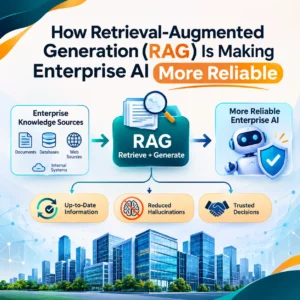
This is where Retrieval-Augmented Generation (RAG) becomes valuable. RAG combines information retrieval techniques with large language models (LLMs) to generate responses using relevant external data. Instead of depending entirely on information learned during training, an AI application can retrieve useful business information and use it as context before generating an answer.
For enterprises handling large amounts of business data, this approach can make AI applications more useful, context-aware and dependable.
Retrieval-Augmented Generation is an AI architecture that connects a language model with an external knowledge source. When a user submits a question, the system searches its connected data sources for relevant information. The retrieved content is then provided to the language model, which uses that context to generate a response.
For example, imagine an employee asking an internal AI assistant about a company’s leave policy. A conventional language model might provide a general answer based on its training. A RAG-powered application can retrieve the organisation’s actual HR policy and generate a response based on the available document.
This makes the answer more relevant to the organisation’s requirements.
Large language models are capable of understanding questions and generating natural-sounding responses. However, using them independently can create challenges for organisations.
Some common limitations include:
RAG helps address these challenges by connecting AI models to relevant external knowledge sources.
A typical RAG architecture follows a series of steps to retrieve information and generate responses.
The first step involves gathering information from different sources, including company documents, knowledge bases, websites, databases and internal reports.
The collected information is processed into smaller sections called chunks. This makes it easier for the system to identify relevant information when users submit questions.
The prepared text is converted into numerical representations called embeddings. These representations help AI systems understand the semantic meaning of information rather than relying only on exact keyword matches.
The embeddings are generally stored in a vector database, where they can be searched efficiently.
When a user enters a question, the system converts the query into an embedding and searches the available knowledge base for related information.
The retrieval process identifies the most relevant content based on semantic similarity and other configured search criteria.
The retrieved information is passed to a large language model along with the original question.
The model uses the supplied context to generate a response that is more closely aligned with the available business information.
The application presents the generated response to the user. Depending on the implementation, it can also provide document references or source links so users can verify the information.
RAG provides AI models with relevant information before they generate answers. This reduces dependence on general training knowledge and helps applications respond using business-specific information.
However, retrieval quality and source accuracy remain important. RAG can reduce hallucinations but cannot eliminate them completely.
Enterprise information changes regularly. Pricing, company policies, product specifications and operational procedures may need frequent updates.
With a properly maintained knowledge base, businesses can update their source information without retraining the entire language model whenever a document changes.
Large organisations often maintain information across multiple departments and platforms. Employees may spend considerable time searching for the right documents or locating specific details.
RAG-powered assistants can make internal information easier to discover by allowing employees to ask questions in natural language.
Businesses can integrate RAG into customer support applications to help users find accurate product information, service details, troubleshooting instructions and frequently asked questions.
This can improve response consistency and reduce the amount of repetitive work handled by support teams.
RAG allows organisations to connect AI applications with selected knowledge sources instead of relying entirely on a model’s general knowledge.
With suitable access controls, data permissions and security measures, businesses can restrict information retrieval according to user roles and organisational requirements.
Retrieval-Augmented Generation can support different enterprise requirements across industries.
These applications demonstrate how RAG can connect conversational AI with specialised information.
Although RAG offers significant opportunities, successful implementation requires proper planning.
Poor-quality source documents can produce unreliable responses. Incorrect document segmentation may prevent the system from retrieving important context. Large knowledge bases can also introduce performance and infrastructure costs.
Businesses should focus on data cleaning, effective embedding strategies, retrieval optimisation, access permissions and regular knowledge-base updates.
It is equally important to evaluate generated responses through testing and human review, particularly when AI supports sensitive business operations.
Implementing enterprise AI requires more than connecting a language model to a database. Businesses need an architecture that supports their data requirements, application workflows, security expectations and future growth.
Apeeak Technology focuses on software development and modern technology solutions that can help organisations explore AI-powered application opportunities. A well-planned RAG implementation can connect business knowledge with conversational interfaces, helping employees and customers access relevant information more efficiently.
By combining suitable AI models, retrieval systems, database technologies and application development practices, businesses can build solutions aligned with their operational needs.
Retrieval-Augmented Generation is creating new possibilities for enterprise AI by connecting language models with relevant and updated business information. It helps organisations develop applications that deliver more context-aware responses, improve knowledge discovery and support everyday workflows.
As businesses continue adopting AI, RAG can become an important part of building practical and reliable enterprise applications. With the right data preparation, retrieval strategy and security framework, organisations can move beyond generic AI interactions towards solutions that understand their specific business requirements.
RAG is an AI architecture that retrieves relevant information from external knowledge sources and provides it to a language model to generate context-based responses.
It supplies the language model with relevant business information before response generation, helping reduce unsupported answers and improve contextual relevance.
No. RAG generally allows organisations to update their external knowledge sources without retraining the underlying language model whenever information changes.
Healthcare, finance, education, e-commerce, software development and customer service are among the industries that can benefit from RAG-powered applications.
RAG applications commonly use large language models, embedding models, vector databases, document processing systems, retrieval frameworks and application APIs. The exact technology stack depends on the project requirements.