Understand business needs objectives
Propose tech stack, timelines architecture
Sprint-based development with regular demos
Final testing and go-live with complete documentation
Ongoing maintenance, upgrades scale-up
Understand business needs objectives
Propose tech stack, timelines architecture
Sprint-based development with regular demos
Final testing and go-live with complete documentation
Ongoing maintenance, upgrades scale-up

We help define the ideal stack
Our architects suggest best options
With estimation, milestones & approach
Flexible delivery model: fixed or dedicated

Get expert tech consultation at no cost.
Get Free Tech AdviceBrief us on your needs (tech stack, duration, etc.)
Receive matched profiles within 24–48 hours
Interview the candidates and choose the right fit
Kick off the project seamlessly with our support

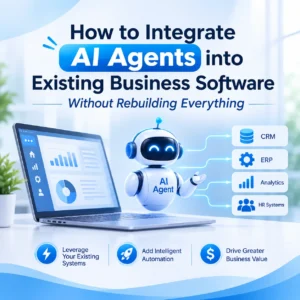
Businesses are increasingly exploring artificial intelligence to improve productivity, automate repetitive tasks, and deliver better customer experiences. However, adopting AI does not always mean replacing existing software or investing in an entirely new technology infrastructure. Companies can integrate AI agents into their current business applications and make their existing systems smarter without rebuilding everything from scratch.
AI agents are intelligent software systems that can understand instructions, analyse information, make decisions based on defined objectives, and perform specific tasks. When connected to existing business applications, they can help organisations simplify daily operations, reduce manual work, and improve decision-making.
Let’s explore how businesses can introduce AI agents into their existing software environments effectively.
Before implementing AI agents, businesses should evaluate their current software infrastructure. Most organisations already use applications such as CRM platforms, ERP systems, inventory management software, customer support tools, and accounting applications.
The first step is identifying which processes could benefit from AI automation.
For example:
Understanding existing workflows helps businesses identify practical AI integration opportunities instead of introducing unnecessary technology.
Businesses do not necessarily need to replace their existing applications to introduce AI capabilities. Several integration approaches allow AI agents to communicate with current software systems.
API Integration: Application Programming Interfaces (APIs) allow different software applications to exchange information. Businesses can connect AI services with their existing CRM, ERP, or other applications through APIs.
Webhook Integration: Webhooks allow applications to send automatic notifications when specific events occur. For example, when a customer submits an enquiry, a webhook can trigger an AI agent to analyse the request and prepare an appropriate response.
Middleware Integration: Middleware acts as a communication layer between different applications. It can help connect older business systems with modern AI services when direct integration is difficult.
Selecting the right approach depends on the existing technology stack, integration requirements, security needs, and available development resources.
One common mistake businesses make is attempting to automate every department at once. A better approach is to begin with one clearly defined business process.
For example, an AI agent could initially handle incoming customer enquiries by identifying their intent, categorising requests, and directing them to the appropriate department.
Other useful starting points include:
Starting with smaller tasks makes it easier to measure results, identify technical challenges, and improve the integration before expanding its capabilities.
AI agents become more useful when they can access relevant and accurate business information.
For example, an AI-powered customer support agent connected to a CRM system can retrieve customer details, review previous interactions, and provide more relevant assistance.
However, businesses should establish clear data access permissions. AI agents should only access information required to complete their assigned tasks.
Developers can use APIs, secure database connections, and controlled data retrieval systems to provide the necessary information without exposing the entire business database.
It is also important to maintain data accuracy, implement access controls, and follow applicable data protection requirements.
Choosing the right AI technology is another important part of successful integration. Different AI models offer different capabilities, and businesses should select solutions according to their requirements.
For example, language models can help understand customer messages, generate summaries, and process natural language instructions. Other AI services can support image recognition, document extraction, classification, and predictive analysis.
Developers can also use Python-based AI tools, Laravel applications, and backend APIs to connect AI functionality with existing business software.
The objective should be to select technologies that work with the current infrastructure rather than introducing unnecessary complexity.
AI integration should not compromise business security or operational control.
Businesses should establish authentication, role-based access permissions, encrypted communication, and activity monitoring. Sensitive operations should also include additional approval mechanisms.
For example, an AI agent may prepare a purchase order or suggest an invoice payment, but a responsible employee should review and approve the action before it is completed.
Human oversight is particularly important when AI agents interact with financial records, confidential customer information, or important business operations.
Before making an AI agent available across the organisation, businesses should test it using real-world scenarios and controlled data.
Testing should cover response accuracy, integration reliability, processing speed, security, and error handling.
Businesses should also monitor important performance indicators, including:
Regular monitoring helps developers identify weaknesses and improve AI agent performance over time.
Once the initial integration delivers positive results, businesses can gradually introduce AI agents into other workflows.
For example, an organisation that initially automates customer enquiries may later introduce AI-powered reporting, sales assistance, document processing, and inventory analysis.
This gradual approach allows companies to improve their existing technology infrastructure while controlling development costs and reducing operational disruption.
Instead of rebuilding every application, businesses can introduce intelligent features where they provide measurable value.
Integrating AI agents into existing business software does not require organisations to replace their entire technology infrastructure. With the right integration strategy, APIs, secure data connections, and suitable AI technologies, businesses can introduce intelligent automation into their current applications.
The key is to start with specific business challenges, implement manageable solutions, and expand gradually based on measurable results.
At Appeak Technology, businesses can explore modern software development and AI integration approaches to improve existing applications, streamline workflows, and build more efficient digital operations. A well-planned AI integration strategy can help organisations make better use of their existing software investments while preparing for future business growth.