Understand business needs objectives
Propose tech stack, timelines architecture
Sprint-based development with regular demos
Final testing and go-live with complete documentation
Ongoing maintenance, upgrades scale-up
Understand business needs objectives
Propose tech stack, timelines architecture
Sprint-based development with regular demos
Final testing and go-live with complete documentation
Ongoing maintenance, upgrades scale-up

We help define the ideal stack
Our architects suggest best options
With estimation, milestones & approach
Flexible delivery model: fixed or dedicated

Get expert tech consultation at no cost.
Get Free Tech AdviceBrief us on your needs (tech stack, duration, etc.)
Receive matched profiles within 24–48 hours
Interview the candidates and choose the right fit
Kick off the project seamlessly with our support

As businesses expand, their technology requirements become more complex. Increasing website traffic, growing customer databases, application performance, data security, and software deployment speed all require a reliable technology infrastructure. Traditional infrastructure management may struggle to support these changing demands, making cloud computing and DevOps practices essential for modern businesses.
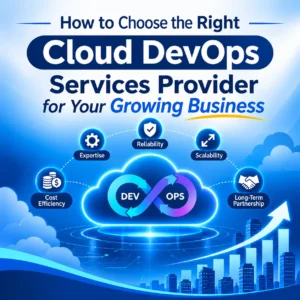
However, choosing the right cloud DevOps services provider is an important decision. The right technology partner can help businesses improve operational efficiency, reduce infrastructure management challenges, strengthen security, and prepare applications for future growth. Understanding what to look for before selecting a provider can help businesses make a more informed investment.
Before selecting a cloud DevOps provider, identify your current technology challenges and long-term business objectives. Every business has different infrastructure requirements depending on its application size, industry, customer base, and development processes.
For example, a startup launching its first SaaS application may need affordable cloud hosting and automated deployment. An established enterprise may require advanced infrastructure management, continuous monitoring, disaster recovery, and multi-environment deployment.
Consider the following requirements:
Having a clear understanding of these requirements will make it easier to identify a provider that offers suitable solutions.
A reliable cloud DevOps services provider should understand different cloud platforms and their capabilities. AWS, Microsoft Azure, and Google Cloud Platform offer various services for hosting applications, managing databases, processing data, and building scalable infrastructure.
Your provider should help you select the right platform based on your business requirements rather than recommending technology without considering its practical value.
For instance:
Ask potential providers about their experience with cloud architecture, migration planning, infrastructure configuration, and ongoing management.
DevOps automation helps development and operations teams collaborate more effectively while reducing repetitive manual activities. It can improve software delivery speed, deployment consistency, and application reliability.
Look for providers experienced in implementing Continuous Integration and Continuous Delivery (CI/CD) pipelines. These processes automate important development stages, including code integration, testing, security checks, and application deployment.
A capable provider should also understand tools such as Docker, Kubernetes, Terraform, and GitHub Actions.
With the right automation strategy, businesses can release software updates more efficiently, minimize deployment errors, and maintain consistent environments across development, testing, and production.
Cloud security should never be treated as an optional service. Businesses store important information, customer records, application data, and operational resources within their cloud environments.
A professional provider should follow security practices that protect infrastructure from unauthorized access, vulnerabilities, and potential data loss.
Important security capabilities include:
Also, discuss how the provider handles security updates, access permissions, incident response, and business continuity.
Cloud infrastructure requires continuous visibility to maintain application availability and performance. Without proper monitoring, businesses may experience unexpected downtime, slow response times, or infrastructure failures.
Your selected provider should offer monitoring solutions that track server performance, resource utilization, application health, and unusual system activity.
Automated alerts can help technical teams identify potential issues before they significantly affect users. Performance optimization and auto-scaling capabilities can also help applications manage increasing traffic without unnecessary infrastructure expenses.
Ask whether the provider offers monitoring dashboards, performance reports, and a defined incident management process.
Cloud services involve ongoing costs, including computing resources, storage, networking, monitoring, and technical support. Therefore, understanding the pricing structure is essential before signing an agreement.
Avoid selecting a provider based only on the lowest initial quotation. Instead, evaluate the overall value of the services, infrastructure quality, support arrangements, and potential long-term expenses.
A suitable provider should explain:
Ask about cloud cost optimization practices, resource allocation, and unused infrastructure management. These measures can help businesses control spending while maintaining performance.
Cloud infrastructure is an important part of daily business operations. Technical problems, deployment failures, or unexpected outages can affect customer experiences and business productivity.
Therefore, communication and support should be important selection criteria.
Check whether the provider offers clearly defined service agreements, support channels, escalation procedures, and maintenance schedules. You should also understand their response commitments and availability during critical incidents.
A good technology partner communicates technical decisions clearly and keeps your team informed about infrastructure changes, risks, and improvements.
Your cloud infrastructure should be capable of supporting future business requirements. As your organization expands, you may need additional computing capacity, container orchestration, automated deployments, advanced monitoring, or AI-ready infrastructure.
Choose a provider that can adapt its services as your business evolves rather than focusing only on immediate requirements.
Appeak Technology helps businesses build and manage cloud environments through cloud architecture, DevOps automation, infrastructure security, CI/CD implementation, and cloud operations. Its technology capabilities include AWS, Azure, GCP, Docker, Kubernetes, Terraform, and GitHub Actions.
Explore the Cloud & DevOps Services offered by Appeak Technologies to understand how cloud infrastructure and DevOps practices can support your business requirements.
Choosing the right cloud DevOps services provider requires more than comparing prices or selecting popular cloud technologies. Businesses should evaluate technical expertise, security practices, automation capabilities, monitoring, scalability, and ongoing support before making a decision.
The right partner can help create a reliable technology foundation, simplify infrastructure management, and improve software delivery processes. By considering both current requirements and future business goals, organizations can make better cloud investment decisions and build infrastructure that supports sustainable growth.
Cloud DevOps services combine cloud infrastructure management with development and operations practices. They help businesses automate deployments, manage infrastructure, improve application performance, and maintain reliable software delivery.
Evaluate the provider’s experience with AWS, Azure, and GCP, DevOps automation capabilities, infrastructure security, monitoring solutions, pricing transparency, and technical support.
AWS, Azure, and Google Cloud are all suitable options. The best platform depends on application requirements, existing technology, budget, scalability needs, and integration requirements.
Yes. DevOps automation can reduce repetitive manual work, improve deployment efficiency, minimize configuration errors, and optimize infrastructure resource utilization.
Businesses should consider professional cloud DevOps support when infrastructure becomes difficult to manage, application traffic increases, deployments become frequent, security requirements grow, or internal teams need specialized cloud expertise.