Understand business needs objectives
Propose tech stack, timelines architecture
Sprint-based development with regular demos
Final testing and go-live with complete documentation
Ongoing maintenance, upgrades scale-up
Understand business needs objectives
Propose tech stack, timelines architecture
Sprint-based development with regular demos
Final testing and go-live with complete documentation
Ongoing maintenance, upgrades scale-up

We help define the ideal stack
Our architects suggest best options
With estimation, milestones & approach
Flexible delivery model: fixed or dedicated

Get expert tech consultation at no cost.
Get Free Tech AdviceBrief us on your needs (tech stack, duration, etc.)
Receive matched profiles within 24–48 hours
Interview the candidates and choose the right fit
Kick off the project seamlessly with our support

Artificial intelligence is changing how businesses develop and use web applications. From intelligent chatbots and personalized recommendations to automated customer support and AI-powered search, modern applications need flexible, responsive, and scalable frontend technologies.
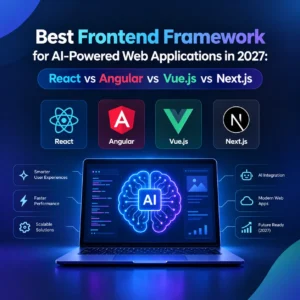
Choosing the right frontend framework in 2027 involves more than development speed. Businesses must consider performance, search engine optimization, security, maintainability, and how easily AI services can be integrated. React, Angular, Vue.js, and Next.js are four popular options, but each serves different development needs.
React is a widely used JavaScript library for building interactive user interfaces. Its component-based architecture allows developers to create reusable elements, making it suitable for applications that require frequent updates and dynamic content.
React works well for AI chat interfaces, recommendation dashboards, intelligent search tools, and real-time data visualization. Developers can connect React applications to AI model APIs through a backend service and display generated responses in an intuitive interface.
Its large ecosystem also provides libraries for managing application state, handling forms, and creating interactive components. However, React alone does not provide every feature required for a complete application. Developers may need additional tools for routing, server-side rendering, and other requirements.
Best for: Interactive AI applications, dashboards, customer portals, and products requiring a flexible frontend.
Angular is a comprehensive web application framework designed to support structured development. It includes capabilities for routing, dependency injection, forms, and application organization, making it suitable for complex business software.
For AI-powered enterprise applications, Angular can provide the frontend for intelligent reporting systems, workflow automation platforms, customer management tools, and internal business assistants. Its structured architecture can help larger development teams maintain consistency as an application grows.
Angular can communicate with backend services that process AI requests, retrieve business information, and return results to users. However, its broader framework structure may introduce additional learning requirements for teams building small or simple applications.
Best for: Enterprise platforms, large business applications, complex workflows, and projects that benefit from a consistent development structure.
Vue.js offers an approachable way to build interactive web interfaces. Its progressive design allows developers to introduce Vue into an existing website or use it to build a complete frontend application.
Vue can support AI-powered customer service widgets, smart product filters, personalized content interfaces, and lightweight business tools. Its component system makes it possible to update individual interface elements without rebuilding the entire page.
For startups and businesses with limited development resources, Vue may offer a comfortable balance between flexibility and simplicity. Like React and Angular, it can integrate with AI services through APIs and backend systems.
The right implementation still requires attention to performance, accessibility, data handling, and application architecture.
Best for: Startups, interactive websites, lightweight applications, and projects that prioritize development simplicity.
Next.js is a React-based framework that adds features for building complete web applications. Depending on the implementation, it supports server rendering, static generation, server-side logic, and other approaches that help developers balance performance with dynamic functionality.
These capabilities can be valuable for AI-powered SaaS products, intelligent e-commerce websites, content platforms, and applications that need discoverable public pages alongside personalized user experiences.
For example, a business could use Next.js to publish search-friendly product pages while offering an AI assistant to help visitors compare products. Server-side functionality can also help protect sensitive API credentials when implemented correctly.
Next.js does not guarantee high rankings or superior performance by default. Results depend on rendering choices, caching, content quality, technical SEO, and application design.
Best for: AI-powered websites, SaaS platforms, content-driven products, and applications combining SEO with interactive functionality.
The best technology depends on the project’s goals rather than which framework is currently receiving the most attention.
All four technologies can support AI integration. The frontend manages the user experience, while backend services typically handle AI model requests, business rules, permissions, and sensitive data.
AI adoption involves more than connecting a chatbot to a website. Businesses may need document analysis, semantic search, personalized recommendations, AI-generated summaries, and intelligent workflow automation.
Frontend frameworks provide the interface through which users access these capabilities. The backend usually manages model communication, authentication, data permissions, usage limits, and validation.
Developers should also consider loading indicators, error handling, accessibility, and clear explanations when AI-generated results may be inaccurate.
For additional insights, read How AI Is Changing Modern Front-End Development: From Smart Interfaces to Better User Experiences.
Businesses can also explore AI development and AI-powered solutions to understand how AI integration, intelligent applications, and automation can support different business goals.
Before starting development, businesses should evaluate several factors:
Explore frontend development technologies to learn more about modern frontend options, including React, Angular, Vue.js, and Next.js.
When planning a new AI-enabled digital product, Appeak Technology can be considered when evaluating web development and AI integration services. The final technology choice should follow the project’s requirements, budget, and future roadmap.
There is no single frontend framework that is best for every AI-powered web application in 2027. React offers flexibility, Angular provides a structured environment for complex applications, and Vue.js delivers an approachable development experience. Next.js is particularly worth considering for projects that combine React-based interfaces, flexible rendering, and search-friendly public content.
For businesses prioritizing AI integration alongside SEO, Next.js is a strong starting point, while React remains a versatile alternative for interactive applications. Angular and Vue.js are equally worth evaluating when their architecture better matches the project.
Ultimately, successful AI-powered applications depend on sound architecture, secure backend integration, useful AI features, and a smooth user experience—not simply the choice of framework. Appeak Technology can help businesses evaluate these requirements when planning their next web application.