Understand business needs objectives
Propose tech stack, timelines architecture
Sprint-based development with regular demos
Final testing and go-live with complete documentation
Ongoing maintenance, upgrades scale-up

Understand business needs objectives
Propose tech stack, timelines architecture
Sprint-based development with regular demos
Final testing and go-live with complete documentation
Ongoing maintenance, upgrades scale-up

We help define the ideal stack
Our architects suggest best options
With estimation, milestones & approach
Flexible delivery model: fixed or dedicated

Get expert tech consultation at no cost.
Get Free Tech AdviceBrief us on your needs (tech stack, duration, etc.)
Receive matched profiles within 24–48 hours
Interview the candidates and choose the right fit
Kick off the project seamlessly with our support

Artificial Intelligence (AI) is rapidly changing the way modern websites and digital applications are designed and developed. Front-end development, which focuses on the visual and interactive parts of a website, is becoming more intelligent through the use of AI-powered tools and technologies.
Modern users expect websites to be fast, intuitive, accessible, responsive, and easy to navigate across different devices. AI can help developers and businesses meet these expectations by supporting smarter interfaces, personalized experiences, automated testing, and more efficient development workflows.
From AI-assisted coding to intelligent user interfaces, the combination of AI and front-end development is creating new opportunities for businesses to deliver better digital experiences.
One of the biggest changes AI brings to front-end development is the ability to assist developers throughout the coding process. AI-powered development tools can generate code suggestions, explain existing code, identify potential errors, and help developers complete repetitive programming tasks.
For example, developers working with JavaScript, React, Vue.js, or other modern front-end technologies can use AI assistance to speed up routine development activities. This allows developers to spend more time focusing on application architecture, business requirements, performance, and user experience.
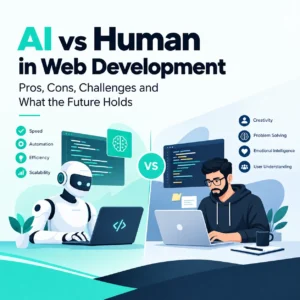
AI does not replace the expertise of experienced developers. Instead, it can act as an intelligent assistant that helps development teams work more efficiently while maintaining human oversight and technical decision-making.
AI is helping websites become more intelligent and personalized. Instead of presenting the same experience to every visitor, AI-powered systems can analyze user behavior and adapt certain elements of the interface.
For example, an e-commerce website may display product recommendations based on browsing history, previous interactions, or customer preferences. A content platform can suggest articles or videos based on the user’s interests.
AI can also help create interfaces that respond to user behavior. This can make websites feel more relevant and intuitive, potentially improving engagement and customer satisfaction.
User experience is a critical factor in the success of any website or web application. AI can analyze large amounts of user interaction data to identify patterns and opportunities for improvement.
Businesses can use AI-driven insights to understand how users navigate websites, where they encounter difficulties, and which sections receive the most engagement. These insights can help developers and UX teams make more informed design decisions.
AI can also support A/B testing and conversion optimization by helping teams analyze different versions of web pages and understand which experiences perform better.
Front-end development often includes repetitive tasks such as writing standard components, creating documentation, generating test cases, and debugging common issues. AI-powered tools can help automate or accelerate some of these activities.
Developers can use AI to generate initial code structures, create reusable components, and receive suggestions while working on projects. This can reduce development time and help teams move from an initial concept to a working product more efficiently.
However, AI-generated code should always be reviewed and tested by skilled developers. Code quality, security, scalability, and maintainability still require professional oversight.
Responsive design ensures that websites work effectively across desktops, tablets, and smartphones. AI can contribute to the development of more adaptive digital experiences by analyzing device characteristics and user behavior.
For example, AI-powered systems can help determine which content or interface elements are most relevant to different users and contexts. This can support the creation of dynamic experiences that adapt to individual needs.
When combined with responsive design principles and modern front-end frameworks, AI can help businesses deliver more flexible and engaging digital experiences across multiple devices.
Accessibility is an important part of modern web development. Websites should be designed so that people with different abilities can access and interact with digital content.
AI can assist developers in identifying certain accessibility issues, analyzing website content, and supporting features such as automated image descriptions, speech recognition, and intelligent navigation.
Although AI can help identify potential accessibility improvements, developers should still follow established accessibility standards and conduct appropriate testing with real users and assistive technologies.
Testing is an essential part of front-end development. Identifying bugs before a website or application reaches users can improve reliability and reduce maintenance costs.
AI-powered testing tools can assist developers by analyzing code, identifying potential problems, generating test scenarios, and detecting unusual behavior. Some AI systems can also help prioritize issues based on their potential impact.
This can make testing workflows more efficient and help development teams identify problems earlier in the development lifecycle.
The future of front-end development is likely to involve closer collaboration between developers and AI-powered tools. AI may increasingly assist with code generation, design creation, accessibility analysis, testing, personalization, and performance optimization.
We may also see more intelligent interfaces that understand user intent and dynamically adjust content and functionality. Voice interfaces, conversational experiences, AI agents, and personalized digital environments could become more common across websites and applications.
However, successful AI adoption will depend on responsible implementation. Developers will need to consider data privacy, security, accessibility, ethical design, and the quality of AI-generated outputs.
AI is changing modern front-end development by helping developers create smarter interfaces, improve workflows, optimize user experiences, and build more personalized digital products. From AI-assisted coding and automated testing to intelligent personalization and accessibility support, the technology is influencing almost every stage of the front-end development process.
For businesses, the combination of AI and modern front-end technologies can create opportunities to build faster, more engaging, and user-focused digital experiences. As AI continues to evolve, developers who combine these new tools with strong technical skills, creativity, and human judgment will be better positioned to build the next generation of web experiences.