Understand business needs objectives
Propose tech stack, timelines architecture
Sprint-based development with regular demos
Final testing and go-live with complete documentation
Ongoing maintenance, upgrades scale-up
Understand business needs objectives
Propose tech stack, timelines architecture
Sprint-based development with regular demos
Final testing and go-live with complete documentation
Ongoing maintenance, upgrades scale-up
We help define the ideal stack
Our architects suggest best options
With estimation, milestones & approach
Flexible delivery model: fixed or dedicated
Get expert tech consultation at no cost.
Get Free Tech AdviceBrief us on your needs (tech stack, duration, etc.)
Receive matched profiles within 24–48 hours
Interview the candidates and choose the right fit
Kick off the project seamlessly with our support

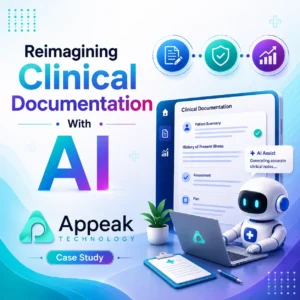
Clinical documentation is an essential part of modern mental healthcare, but it can also become one of the most time-consuming administrative responsibilities for therapists, counselors, psychologists, and other professionals. Detailed records need to be accurate, organized, secure, and completed consistently, often while providers are trying to maintain meaningful conversations with clients.
This is where artificial intelligence can make a practical difference. Rather than replacing professional judgment, AI can help reduce repetitive documentation work and create a more structured workflow. This case study explores how Appeak Technology approached this challenge while developing an AI-assisted clinical documentation platform designed around the needs of mental health professionals.
Mental health providers often need to create several types of records, including assessments, treatment plans, progress notes, and discharge summaries. Producing these documents manually can take considerable time, particularly when similar information needs to be entered across multiple records.
Documentation becomes even more challenging for professionals conducting remote sessions. They need to capture important information while maintaining attention on the client and keeping the interaction natural.
There are also important considerations surrounding privacy and access. Clinical records contain sensitive information, making secure storage, controlled permissions, and appropriate data handling essential requirements for healthcare software.
The challenge, therefore, was not simply to create an AI note generator. The objective was to build a complete AI-powered clinical documentation workflow that could support providers from client information management through document creation, review, customization, and secure storage.
The solution developed by Appeak Technology was designed around a structured documentation process rather than a single automated feature.
The workflow follows a straightforward sequence:
Add Client → Select Document Type → Choose Keywords → Generate → Review → Customize → Save
This approach allows professionals to provide relevant information before the system generates a structured draft. Instead of starting every document from an empty page, providers receive an initial document that they can evaluate and modify.
This distinction is important. AI-generated content should not automatically become the final clinical record. The professional remains responsible for reviewing the information and deciding what should ultimately be included.
The result is an AI-assisted clinical documentation process that combines automation with human oversight.
The platform supports several documentation workflows that commonly require substantial manual effort.
An assessment generator can help create a structured starting point for assessment documentation. Treatment plan generation can help organize relevant information into a usable format. Progress note generation can support post-session documentation, while discharge summary generation can assist when a client’s treatment journey comes to an end.
These capabilities are designed to reduce repetitive writing rather than remove the provider from the process.
Professionals can review generated information, make corrections, add their own observations, change formatting, or override generated content completely. This provides flexibility for different documentation styles and professional requirements.
One of the most important principles behind the platform is human control.
Healthcare applications need to recognize that professional documentation cannot always be reduced to a fixed template. Different practitioners may have different preferences, workflows, and documentation requirements.
The platform therefore allows users to edit and customize generated documents before saving them. This creates a balance between automation and professional judgment.
For Appeak Technology, the goal was not simply to automate documentation. It was to create technology that supports professionals while preserving their ability to make the final decisions about their records.
Healthcare documentation requires strong attention to security. A platform handling sensitive client information needs controlled access and appropriate data-management practices.
The solution incorporates secure client records and role-based management to support different organizational structures. Administrators can manage users and platform-level activities, while supervisors can support review processes and clinicians can focus on their assigned clients and documentation.
This architecture also makes the platform suitable for different practice environments, from individual professionals to larger organizations with multiple users or locations.
Telehealth has introduced new expectations for digital healthcare applications. Providers need technology that supports documentation without creating unnecessary distractions during client sessions.
The platform incorporates a simplified interface for remote documentation workflows. Providers can focus on relevant keywords and information while maintaining a cleaner session environment.
After the session, the information can be developed into a more complete document for review and customization.
This approach demonstrates how healthcare SaaS development can address not just documentation itself, but the broader workflow surrounding it.
Building a healthcare SaaS product requires a reliable technical foundation. The platform uses React.js for the interactive frontend experience, Laravel for backend functionality and application logic, and MySQL for managing application data.
The architecture supports important capabilities such as authentication, role-based access, client management, document workflows, secure records, and AI-assisted functionality.
This combination provides a foundation that can be expanded as organizational requirements evolve.
The platform delivered a measurable improvement in documentation efficiency. Users reported an average 60% reduction in time spent creating notes.
However, efficiency was only one part of the outcome.
Structured workflows can improve documentation consistency, while centralized records make information easier to manage. Customization features provide clinicians with greater control, and role-based functionality supports organizations with different levels of responsibility.
Most importantly, reducing repetitive administrative work can give professionals more opportunity to focus their attention on clients rather than spending excessive time preparing documentation.
The future of healthcare technology is unlikely to be defined by automation alone. Successful solutions need to combine intelligent technology with security, usability, professional oversight, and practical workflows.
This project demonstrates how AI-powered clinical documentation can become part of a broader digital ecosystem rather than functioning as an isolated AI feature.
By combining AI-assisted generation, secure records, customizable documents, remote-session support, and role-based management, the platform provides a more connected approach to clinical documentation.
For businesses exploring healthcare SaaS development, this case also highlights the importance of understanding the real-world workflow before selecting technologies or implementing AI.
Clinical documentation will remain an important responsibility for mental healthcare professionals, but the process does not have to remain entirely manual.
The TheraNote Pro project demonstrates how thoughtfully implemented AI can reduce repetitive work while keeping clinicians firmly involved in the documentation process. From generating structured drafts to reviewing, editing, customizing, and securely storing records, the workflow is designed to support professionals at every stage.
Appeak Technology approached the project with a focus on intelligent automation, secure architecture, scalability, and human-centered design. The result is a healthcare SaaS solution that demonstrates how technology can help transform a complex administrative process into a more efficient and manageable workflow.
As AI continues to evolve, the strongest healthcare applications will likely be those that use automation to assist professionals—not replace the expertise, responsibility, and judgment they bring to their work.