Understand business needs objectives
Propose tech stack, timelines architecture
Sprint-based development with regular demos
Final testing and go-live with complete documentation
Ongoing maintenance, upgrades scale-up
Understand business needs objectives
Propose tech stack, timelines architecture
Sprint-based development with regular demos
Final testing and go-live with complete documentation
Ongoing maintenance, upgrades scale-up

We help define the ideal stack
Our architects suggest best options
With estimation, milestones & approach
Flexible delivery model: fixed or dedicated

Get expert tech consultation at no cost.
Get Free Tech AdviceBrief us on your needs (tech stack, duration, etc.)
Receive matched profiles within 24–48 hours
Interview the candidates and choose the right fit
Kick off the project seamlessly with our support

Artificial intelligence is changing the way websites and web applications are designed, developed, tested, and maintained. From generating code to identifying bugs and creating design suggestions, AI tools can now support developers throughout many stages of a project. However, the growing role of AI has also created an important question: Can AI replace human web developers?
The answer is more complicated than simply choosing AI or humans. AI can significantly improve development speed and productivity, but human developers continue to provide creativity, strategic thinking, business understanding, and decision-making that technology cannot fully replicate.
Understanding the strengths and limitations of both can help businesses choose a more effective approach to modern web development.
AI-powered development tools can assist with repetitive and time-consuming programming tasks. Developers can use AI to generate code snippets, explain unfamiliar code, identify potential errors, create test cases, and suggest solutions.
AI can also support website content structures, user interface ideas, documentation, and basic troubleshooting. This can reduce the amount of time developers spend on routine work and allow them to concentrate on more complex aspects of a project.
However, AI-generated output still requires human review. Code that appears correct may contain security vulnerabilities, inefficient logic, compatibility problems, or solutions that do not match the project’s actual requirements.
Despite its capabilities, AI has important limitations in professional web development.
Human developers bring qualities that remain essential to successful projects. They can communicate with clients, understand unclear requirements, make architectural decisions, evaluate trade-offs, and adapt solutions when unexpected problems arise.
Experienced developers also consider factors beyond writing code. They think about scalability, maintainability, accessibility, performance, security, user experience, and long-term business goals.
For example, AI might suggest several technical solutions for a feature. A human developer must determine which option is appropriate based on the project’s budget, infrastructure, technology stack, security requirements, and future plans.
While human expertise is essential, relying entirely on manual development also has challenges. Developers may spend considerable time on repetitive coding and testing tasks. Large projects can require substantial development resources, and maintaining consistency across complex applications can become difficult.
Human teams can also make mistakes, particularly when working under tight deadlines. AI assistance can reduce some of this workload by providing suggestions and automating routine activities.
The future of web development is unlikely to be a simple competition between AI and humans. Instead, the strongest approach may involve human-AI collaboration.
AI can handle repetitive tasks, generate initial solutions, analyze code, and support testing. Human developers can provide direction, review results, make important technical decisions, and ensure that the final application meets business and user requirements.
This combination can potentially provide the speed of automation while retaining the judgment and accountability of experienced professionals.
AI will continue to influence web development as development tools become more capable. Developers may increasingly use AI for coding assistance, testing, debugging, documentation, optimization, and application maintenance.
At the same time, the role of developers is likely to evolve. Instead of focusing only on writing code manually, developers may spend more time designing systems, reviewing AI-generated output, managing architecture, solving complex problems, and making strategic decisions.
Businesses should therefore view AI as a productivity tool rather than an automatic replacement for professional expertise.
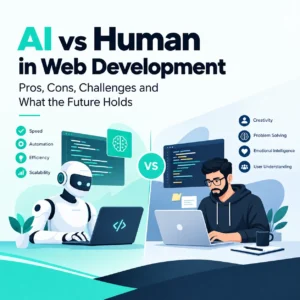
The debate over AI vs human in web development is not really about deciding which one wins. AI offers speed, automation, and valuable technical assistance, while human developers provide creativity, experience, business understanding, critical thinking, and responsibility.
The most effective development teams will likely be those that know how to combine both. By using AI for suitable tasks while keeping humans involved in planning, validation, security, and decision-making, businesses can build web solutions that are faster to develop without compromising quality or long-term value.
AI can automate many development tasks, but complete replacement is unlikely. Human expertise remains important for architecture, business requirements, security, creativity, testing, and complex decision-making.
Yes. AI can assist with coding, debugging, testing, documentation, prototyping, and other development activities. Its output should still be reviewed by experienced developers.
Speed and automation are among its biggest advantages. AI can help developers complete repetitive tasks faster and explore solutions more efficiently.
Potential risks include incorrect logic, outdated approaches, security vulnerabilities, compatibility issues, and code that does not properly address project-specific requirements.
Yes. The role of developers may change as AI becomes more capable, but human professionals will continue to be valuable for strategic planning, system architecture, security, problem-solving, creativity, and quality control.