Understand business needs objectives
Propose tech stack, timelines architecture
Sprint-based development with regular demos
Final testing and go-live with complete documentation
Ongoing maintenance, upgrades scale-up
Understand business needs objectives
Propose tech stack, timelines architecture
Sprint-based development with regular demos
Final testing and go-live with complete documentation
Ongoing maintenance, upgrades scale-up

We help define the ideal stack
Our architects suggest best options
With estimation, milestones & approach
Flexible delivery model: fixed or dedicated

Get expert tech consultation at no cost.
Get Free Tech AdviceBrief us on your needs (tech stack, duration, etc.)
Receive matched profiles within 24–48 hours
Interview the candidates and choose the right fit
Kick off the project seamlessly with our support

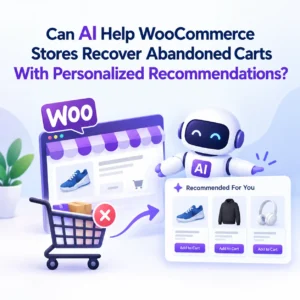
Online shopping makes it easy for customers to explore products, compare prices, and add items to their carts. However, many shoppers leave an online store without completing their purchases. For WooCommerce businesses, abandoned carts can mean lost sales and missed opportunities to build customer relationships.
Traditional recovery methods, such as sending reminder emails or offering discount coupons, can help, but they do not always address the reason a customer left. Artificial intelligence (AI) offers another approach by helping stores understand shopping behavior and recommend products or solutions that match individual customer needs.
With the right strategy, AI can help WooCommerce stores create more relevant shopping experiences, encourage customers to return, and improve the chances of completing a purchase.
Before implementing AI, store owners should understand why shoppers leave. Some customers discover unexpected shipping charges, while others want to compare products or wait until a later date to purchase.
Common reasons include:
Not every abandoned cart represents a lost sale. Some shoppers are simply researching their options. Understanding these different situations helps businesses design recovery campaigns that are useful rather than intrusive.
AI can analyze available shopping signals, such as previously viewed products, cart contents, purchase history, and product preferences, to suggest relevant items.
For example, a customer adding a camera to their WooCommerce cart might also be interested in a compatible memory card or camera bag. A personalized reminder could highlight a useful accessory instead of displaying unrelated products.
These recommendations should complement the original purchase rather than distract customers with unnecessary alternatives. The goal is to help shoppers find what they need and make confident decisions.
A generic email saying that an item remains in the cart may not give a shopper a compelling reason to return. AI can help tailor reminder messages according to the products involved and the customer’s shopping journey.
For instance, a reminder could feature the exact product, explain a relevant benefit, or suggest an alternative when the original item is unavailable. A customer comparing two similar products might receive a useful comparison rather than an immediate discount offer.
Businesses can also test different message timings and subject lines. However, messages should respect customer consent, communication preferences, and applicable privacy requirements.
Sometimes, shoppers abandon carts because they are unsure whether a product suits their needs. AI-powered shopping assistants can help answer product-related questions and guide customers toward suitable options.
A shopper purchasing running shoes, for example, might need information about cushioning, sizing, or intended use. An assistant connected to accurate product information can help clarify these details and recommend relevant alternatives.
This approach connects cart recovery with customer support. Instead of simply asking shoppers to return, the store helps resolve the questions that may have prevented them from purchasing.
Offering a discount to every customer who abandons a cart can reduce profit margins and encourage shoppers to delay purchases until a coupon arrives.
AI can help businesses evaluate available signals to decide when an incentive may be appropriate. A high-value cart, repeated visits, or a customer’s response to previous promotions could inform the decision.
However, recommendations should follow clear business rules. Store owners should establish minimum margins, discount limits, and eligibility conditions. AI predictions should support these decisions rather than automatically override pricing policies.
The right message delivered at the wrong time may be ineffective. AI can help identify patterns in customer engagement and suggest when reminders are more likely to be useful.
A store might discover that certain product categories perform better with an early reminder, while others benefit from additional time for consideration. Testing these patterns can help businesses improve campaign timing.
Results should be evaluated using completed purchases and revenue, not email opens alone.
Businesses do not necessarily need to rebuild their entire online store to introduce AI. A phased implementation is often more practical.
Step 1: Set up reliable cart tracking. Capture relevant cart events, product information, and purchase completion while respecting privacy requirements.
Step 2: Choose an appropriate recovery solution. Evaluate WooCommerce-compatible tools or custom integrations that support abandoned cart tracking, personalized messages, and recommendation features.
Step 3: Connect relevant data. Depending on the solution, AI may use product descriptions, inventory availability, customer preferences, and historical order information.
Step 4: Define recovery rules. Set limits for message frequency, discounts, product recommendations, and customer eligibility.
Step 5: Test and improve. Compare AI-assisted campaigns with existing recovery methods to determine whether the new approach produces measurable improvements.
For additional context, read How AI Is Transforming E-Commerce Website Development and Online Shopping, which explores AI-powered personalization and product recommendations across online shopping experiences.
AI implementation should be judged by business outcomes rather than technology alone. Useful metrics include:
Comparing these metrics before and after implementation helps businesses identify which features provide genuine value.
AI can help WooCommerce stores recover abandoned carts by making follow-up messages more relevant, recommending suitable products, answering customer questions, and improving campaign timing. Its effectiveness depends on accurate data, thoughtful implementation, and a clear understanding of customer needs.
Businesses should start with one measurable improvement, test the results, and expand gradually. AI should support a helpful shopping experience rather than pressure customers into purchasing.
For businesses exploring customized eCommerce functionality, AppeakTech can be considered for WooCommerce development, integrations, and AI-powered solutions tailored to specific operational needs.
AI can support automated recovery workflows through compatible plugins, email platforms, and custom integrations. The exact capabilities depend on the tools and configuration used.
Depending on the application, it may use product details, cart contents, browsing behavior, purchase history, and customer preferences. Businesses should collect and process only appropriate data.
No. Discounts can reduce profitability and may be unnecessary when a reminder, product clarification, or relevant recommendation is sufficient.
Not always. Existing plugins may meet the needs of smaller stores, while businesses with complex catalogs, unique workflows, or specialized recommendation requirements may benefit from custom development.
Compare completed purchases, recovery rates, revenue, average order value, and customer complaints against a baseline or control group. This helps distinguish actual improvements from purchases that would have occurred anyway.