Understand business needs objectives
Propose tech stack, timelines architecture
Sprint-based development with regular demos
Final testing and go-live with complete documentation
Ongoing maintenance, upgrades scale-up
Understand business needs objectives
Propose tech stack, timelines architecture
Sprint-based development with regular demos
Final testing and go-live with complete documentation
Ongoing maintenance, upgrades scale-up

We help define the ideal stack
Our architects suggest best options
With estimation, milestones & approach
Flexible delivery model: fixed or dedicated

Get expert tech consultation at no cost.
Get Free Tech AdviceBrief us on your needs (tech stack, duration, etc.)
Receive matched profiles within 24–48 hours
Interview the candidates and choose the right fit
Kick off the project seamlessly with our support

Artificial Intelligence (AI) is changing the way businesses build and operate e-commerce websites. Online shopping has evolved beyond simple product catalogs and checkout pages. Today, customers expect personalized experiences, quick responses, accurate search results, secure payments, and convenient shopping journeys.
AI enables e-commerce businesses to analyze customer behavior, automate repetitive tasks, and make intelligent decisions using large amounts of data. From product recommendations to virtual assistants, AI is becoming an important part of modern e-commerce website development. As AI technology continues to advance, businesses can use it to improve customer experiences while making their online operations more efficient.
Personalization is one of the most valuable applications of AI in online shopping. Traditional e-commerce websites often display similar content to every visitor. AI can help create a more personalized experience based on browsing activity, previous purchases, search history, and customer preferences.
For example, an AI-powered e-commerce platform can recommend products that match a customer’s interests. A customer who frequently searches for fitness products may see relevant shoes, clothing, or accessories when returning to the website.
Personalized product suggestions can make shopping more convenient and help businesses present relevant products to the right customers at the right time.
Finding the right product quickly is essential for a successful online shopping experience. AI can improve e-commerce search functionality by understanding user intent instead of relying only on exact keywords.
AI-powered search systems can interpret natural language queries and provide more relevant results. Visual search is another growing application that allows customers to upload an image and discover similar products.
AI recommendation engines can also analyze customer behavior to suggest related or complementary products. These capabilities can help customers discover products faster and create a smoother shopping journey.
AI-powered chatbots are becoming common across modern e-commerce websites. They can answer frequently asked questions, help customers find products, provide order information, and assist with basic support requests.
Unlike traditional automated systems that follow limited scripts, modern AI assistants can understand natural language and provide more conversational interactions.
For example, a customer could ask, “I need a lightweight laptop for business travel,” and an AI shopping assistant could help narrow down suitable options based on the customer’s requirements.
This technology can improve customer engagement while allowing support teams to focus on more complex issues.
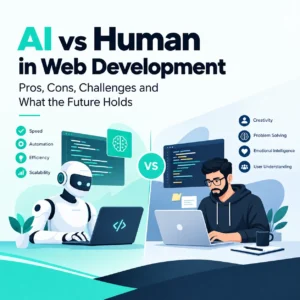
AI is not only changing the customer-facing side of e-commerce but also influencing how websites and applications are developed. Developers can use AI-assisted coding tools to speed up certain development tasks, generate code suggestions, identify potential bugs, and improve productivity.
AI can also support developers in analyzing user behavior and optimizing website interfaces. When combined with technologies such as PHP, Laravel, JavaScript, React, and other modern frameworks, AI can contribute to the development of smarter and more responsive e-commerce platforms.
However, human developers remain essential for architecture, security, testing, performance optimization, and business-specific decision-making.
Managing inventory is a major challenge for e-commerce businesses. Overstocking can increase storage costs, while insufficient inventory can result in missed sales opportunities.
AI can analyze historical sales, customer demand, seasonal trends, and other relevant data to help businesses forecast future demand. These insights can support better inventory planning and supply chain management.
AI-driven forecasting can help businesses make more informed decisions about which products to stock and when to replenish inventory.
Security is a critical concern for every e-commerce website. Online businesses handle sensitive customer information, payment details, and transaction data.
AI can help identify unusual transaction patterns and potentially suspicious activities. By analyzing large volumes of transactions, AI-based systems can assist in detecting anomalies that may indicate fraudulent behavior.
AI can also support automated monitoring and risk analysis, helping businesses strengthen their overall security strategy. However, AI should be combined with strong cybersecurity practices, secure payment gateways, encryption, access controls, and regular security testing.
Customer expectations for fast support are increasing. AI can help e-commerce businesses provide assistance around the clock through automated chat and virtual support systems.
AI tools can handle common questions about shipping, returns, product availability, and order status. For complex problems, the system can transfer the conversation to a human support representative with relevant context.
This combination of AI automation and human expertise can create a more efficient customer service experience.
The future of e-commerce will likely involve deeper integration between AI, automation, data analytics, and immersive technologies. AI-powered voice shopping, intelligent product discovery, advanced personalization, and predictive customer experiences could become increasingly common.
Businesses that adopt AI strategically can improve operational efficiency and deliver more relevant experiences. However, successful implementation requires responsible data management, transparency, privacy protection, and continuous improvement.
AI is transforming both e-commerce website development and the way people shop online. From personalized recommendations and intelligent search to chatbots, inventory forecasting, security, and customer support, AI is helping businesses create smarter digital experiences.
For e-commerce companies, adopting AI is not simply about following a technology trend. It is about understanding customer needs, improving business processes, and creating convenient shopping experiences. As AI technology continues to evolve, businesses and development teams that use it thoughtfully can build more intelligent, efficient, and customer-focused e-commerce platforms for the future.