Understand business needs objectives
Propose tech stack, timelines architecture
Sprint-based development with regular demos
Final testing and go-live with complete documentation
Ongoing maintenance, upgrades scale-up
Understand business needs objectives
Propose tech stack, timelines architecture
Sprint-based development with regular demos
Final testing and go-live with complete documentation
Ongoing maintenance, upgrades scale-up

We help define the ideal stack
Our architects suggest best options
With estimation, milestones & approach
Flexible delivery model: fixed or dedicated

Get expert tech consultation at no cost.
Get Free Tech AdviceBrief us on your needs (tech stack, duration, etc.)
Receive matched profiles within 24–48 hours
Interview the candidates and choose the right fit
Kick off the project seamlessly with our support

Software as a Service (SaaS) platforms are becoming more advanced as businesses look for smarter ways to manage operations, improve customer experiences, and reduce manual work. Artificial Intelligence (AI) is playing an important role in this transformation by helping software applications understand user behaviour, automate processes, and deliver more personalised experiences.
Modern SaaS products are no longer expected to provide only basic functionality. Businesses increasingly want intelligent tools that can analyse information, predict trends, and simplify everyday tasks. Whether developing a new SaaS product or upgrading an existing platform, integrating the right AI capabilities can help create a more competitive and scalable solution.
Here are some essential AI-powered features that businesses should consider when developing a modern SaaS platform.
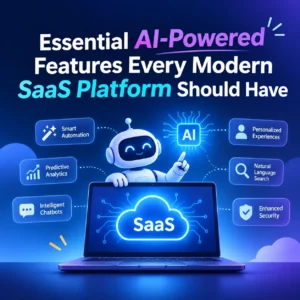
Customer support is an important part of any SaaS business. AI-powered chatbots can help users find information, resolve common questions, understand platform features, and receive assistance without waiting for a support representative.
Unlike traditional rule-based chatbots, AI-powered assistants can understand natural language and provide responses based on the context of a conversation.
For example, a project management SaaS platform could include an AI assistant that helps users create tasks, check project updates, and find important information. This improves accessibility while reducing repetitive customer support requests.
Data analysis is another valuable application of artificial intelligence. SaaS platforms often collect information about user activity, transactions, sales, and business performance. AI can analyse this information to identify patterns and provide useful insights.
Predictive analytics can help businesses forecast demand, identify potential customer churn, monitor performance, and make informed decisions.
For example, a subscription management platform could identify customers who may be considering cancelling their subscriptions based on changes in usage patterns. Businesses can then take appropriate steps to improve customer engagement.
Different users have different requirements, and a single interface may not provide the same value to everyone. AI can help SaaS platforms personalise dashboards, recommendations, notifications, and content according to individual preferences and behaviour.
For example, an eCommerce SaaS application can recommend relevant products based on browsing history and previous purchases. Similarly, a CRM platform can highlight important customer information and suggest relevant follow-up activities.
Personalisation makes applications more relevant, improves user engagement, and helps customers find the features they need more efficiently.
Traditional search functionality often depends on matching exact keywords. However, users may not always know the precise terms needed to find specific information.
AI-powered semantic search can understand the meaning and context behind a search query. This allows users to find relevant documents, products, records, or information even when their wording differs from the original content.
Recommendation systems can further improve the experience by suggesting relevant products, services, documents, or resources based on user preferences and previous interactions.
These features are particularly useful for SaaS platforms handling large amounts of information.
Security is essential for SaaS platforms that manage customer information, financial records, and confidential business data.
AI can help identify unusual activity by analysing login patterns, transaction behaviour, access requests, and other security-related information.
Some useful applications include suspicious login detection, fraud monitoring, unusual transaction alerts, and automated risk assessment.
However, AI should work alongside established security practices such as encryption, access controls, authentication, and regular security testing. Human review and appropriate safeguards are also important when handling sensitive activities.
Natural Language Processing (NLP) allows software applications to understand and process human language. This makes it easier for users to interact with SaaS platforms without navigating multiple menus or complex interfaces.
For example, users could ask an application to summarise a report, locate a customer record, generate a document, or retrieve specific business information using conversational instructions.
Voice-to-text functionality can also help users enter information and interact with applications more conveniently.
These capabilities are particularly useful for productivity software, customer management systems, and enterprise applications.
Adding AI features is not enough if the underlying SaaS platform cannot support growing user activity and increasing data requirements.
A modern SaaS product should have a flexible architecture that supports new integrations, additional users, and evolving business requirements.
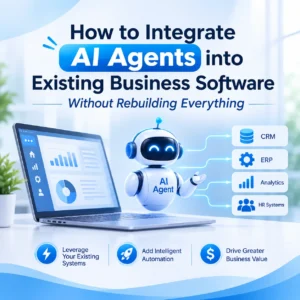
API integrations can connect AI services with databases, CRM platforms, payment systems, communication tools, and other business applications. A modular architecture also makes it easier to introduce additional functionality without rebuilding the entire platform.
Businesses planning AI integration should also consider data privacy, performance, infrastructure costs, and ongoing maintenance.
For further guidance, read AI Integration in Business Software: 7 Questions to Ask Before You Build.
Not every SaaS platform needs every AI capability. The right features depend on the target audience, business objectives, available data, and application requirements.
Start by identifying repetitive tasks, common customer challenges, and areas where intelligent automation could provide measurable improvements. Prioritise features that solve genuine problems instead of adding AI simply because it is becoming popular.
Businesses should also evaluate development costs, integration requirements, data security, and long-term scalability before implementation.
Appeak Technology helps businesses explore modern software development and AI integration opportunities to build practical digital solutions aligned with their requirements.
For additional insights, explore How AI Benefits Software Development in 2026 and Beyond.
AI is changing how modern SaaS platforms operate by introducing intelligent automation, predictive analytics, personalised experiences, and improved security capabilities. These features can help businesses simplify operations, improve customer engagement, and deliver greater value through their software products.
However, successful AI integration requires proper planning, suitable technology, reliable data, and a clear understanding of user requirements. Appeak Technology believes that choosing practical AI features based on real business needs is an important step towards developing scalable and future-ready SaaS applications.