Understand business needs objectives
Propose tech stack, timelines architecture
Sprint-based development with regular demos
Final testing and go-live with complete documentation
Ongoing maintenance, upgrades scale-up
Understand business needs objectives
Propose tech stack, timelines architecture
Sprint-based development with regular demos
Final testing and go-live with complete documentation
Ongoing maintenance, upgrades scale-up

We help define the ideal stack
Our architects suggest best options
With estimation, milestones & approach
Flexible delivery model: fixed or dedicated

Get expert tech consultation at no cost.
Get Free Tech AdviceBrief us on your needs (tech stack, duration, etc.)
Receive matched profiles within 24–48 hours
Interview the candidates and choose the right fit
Kick off the project seamlessly with our support

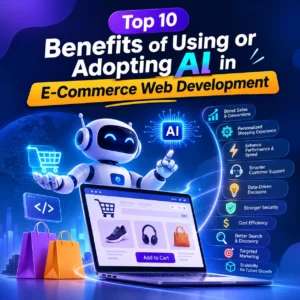
E-commerce businesses are increasingly adopting Artificial Intelligence (AI) to build smarter, more efficient, and scalable online platforms. Beyond improving the shopping experience, AI is changing how developers plan, design, develop, test, and maintain e-commerce websites.
Modern online stores require more than attractive designs and basic shopping functionality. Businesses need flexible website architecture, efficient development processes, seamless third-party integrations, reliable automation, and platforms that can support future growth.
AI can help address these requirements by reducing repetitive development tasks, supporting technical decision-making, improving software testing, and making business operations more efficient.
In this article, we explore the top 10 benefits of adopting AI in e-commerce web development and how businesses can use it to build future-ready online stores.
AI-powered development tools can help developers write code, generate reusable components, identify coding errors, and automate repetitive programming activities.
For example, developers working on product listing pages, checkout functionality, customer dashboards, and payment integrations can use AI-assisted coding tools to accelerate certain development tasks.
This can reduce manual effort and allow development teams to concentrate on complex business requirements, application architecture, and functionality.
Developing and maintaining an e-commerce website involves several activities, including coding, testing, debugging, and regular updates.
AI can assist with repetitive technical tasks, identify potential issues, and help developers troubleshoot problems more efficiently.
Businesses can benefit from better resource utilization and reduced manual effort. However, actual cost savings depend on project complexity, implementation quality, and the level of human supervision required.
Building a scalable e-commerce platform requires proper planning of databases, application structure, APIs, and backend systems.
AI-assisted development tools can help teams evaluate technical requirements, explore architectural approaches, and identify potential implementation challenges.
For example, AI can assist developers in planning database relationships, API structures, and application workflows based on business requirements.
This can support better technical planning and help development teams make more informed decisions before implementation.
Website testing is essential to ensure that an e-commerce platform works correctly across different devices and browsers.
AI-powered testing tools can assist with test case generation, repetitive test execution, bug identification, and regression testing.
For example, developers can use automated testing to check product filtering, shopping cart functionality, checkout processes, and payment workflows.
This helps identify potential issues earlier and supports a more reliable website development process. Human review remains important for validating business logic and critical transactions.
E-commerce websites often depend on external systems such as payment gateways, shipping providers, CRM platforms, ERP software, and marketing applications.
AI-assisted development can help developers understand API documentation, generate integration code suggestions, troubleshoot errors, and document system connections.
This can make complex integration workflows easier to manage and support smoother communication between different business applications.
Managing hundreds or thousands of product listings can become time-consuming for growing online stores.
AI tools can assist with generating initial product descriptions, organizing product attributes, suggesting relevant categories, and identifying missing catalogue information.
For example, an online furniture store can use AI to help organize product details such as material, dimensions, colour, design, and usage.
Human review is necessary to ensure product information remains accurate, consistent, and aligned with the actual items being sold.
AI can support automation across different backend activities, helping businesses reduce repetitive manual work.
Examples include:
By automating suitable tasks, businesses can improve operational efficiency and allow employees to focus on activities that require human judgment.
Accessibility is an important consideration when developing an e-commerce website. Online stores should provide a convenient experience for users with different abilities and browsing requirements.
AI-powered tools can assist developers in identifying potential accessibility issues, reviewing website content, and suggesting improvements to image descriptions, navigation, and page structure.
These capabilities should be combined with established accessibility standards and manual testing to create a more inclusive shopping platform.
Businesses targeting customers across different countries and regions often need multilingual e-commerce websites.
AI-powered translation and language-processing tools can help developers and content teams create initial translations, localize product information, and adapt website content for different audiences.
For example, an Indian e-commerce business targeting international customers may need product information and website content in multiple languages.
AI can simplify parts of this process, while professional review helps maintain accurate translations, cultural relevance, and consistent brand communication.
An e-commerce website needs continuous maintenance to remain secure, functional, and compatible with changing technologies.
AI-assisted development tools can help developers review code, understand technical issues, generate documentation, and identify areas that may require optimization.
They can also support the planning of future features and improvements as business requirements change.
When combined with scalable architecture, proper monitoring, and regular security updates, AI can help development teams manage growing e-commerce platforms more effectively.
AI is creating new opportunities in e-commerce web development by supporting faster coding, efficient testing, better technical planning, smoother integrations, and improved business workflows.
However, adopting AI does not mean replacing experienced developers or relying entirely on automated systems. Businesses need a balanced approach that combines AI capabilities with professional development expertise, secure architecture, accurate data, and continuous quality assurance.
Appeak Technology helps businesses explore modern e-commerce development approaches and intelligent software solutions to build scalable digital platforms. Choosing the right AI technologies and integrating them according to business requirements can help organizations improve development efficiency and prepare their online stores for future growth.
AI helps developers with coding assistance, software testing, technical planning, API integrations, content management, and workflow automation. It can improve development efficiency and support smarter website functionality.
AI can help reduce repetitive manual work and improve development productivity. However, the overall project cost depends on website complexity, required features, integrations, and ongoing maintenance.
Yes. AI can support custom e-commerce development through coding assistance, automated testing, intelligent workflows, and technical documentation. It can be integrated according to specific business requirements.
Yes. AI features can often be integrated into existing websites using APIs, third-party platforms, and custom development. The appropriate approach depends on the website’s technology stack and infrastructure.
Businesses should evaluate their objectives, development budget, data quality, security requirements, integration compatibility, scalability, and ongoing maintenance needs before implementing AI solutions.