- About Us
-
-
Our Blogs
-
-
- Services
-
- Technology
-
- Hire Tech Experts
-
Understand business needs objectives
Propose tech stack, timelines architecture
Sprint-based development with regular demos
Final testing and go-live with complete documentation
Ongoing maintenance, upgrades scale-up
Understand business needs objectives
Propose tech stack, timelines architecture
Sprint-based development with regular demos
Final testing and go-live with complete documentation
Ongoing maintenance, upgrades scale-up

We help define the ideal stack
Our architects suggest best options
With estimation, milestones & approach
Flexible delivery model: fixed or dedicated

Get expert tech consultation at no cost.
Get Free Tech AdviceBrief us on your needs (tech stack, duration, etc.)
Receive matched profiles within 24–48 hours
Interview the candidates and choose the right fit
Kick off the project seamlessly with our support

Artificial Intelligence is transforming the way businesses build web applications, automate workflows, and deliver personalized user experiences. As AI adoption continues to grow in 2026, developers and businesses often ask whether PHP or Python is the better choice for AI development. While Python dominates the AI and machine learning ecosystem, PHP remains a powerful language for building secure, scalable web applications that integrate AI services. The right choice depends on your project goals, technical requirements, and existing technology stack. In this guide, we’ll compare PHP and Python for AI development to help you make an informed decision.
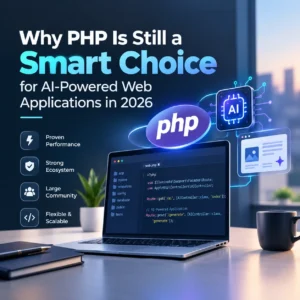
PHP has long been a preferred language for dynamic websites, enterprise portals, eCommerce platforms, and custom web applications. While PHP isn’t designed specifically for machine learning, it has evolved into an excellent choice for integrating AI-powered services into existing applications.
Developers can connect PHP applications with AI APIs such as OpenAI, Google Gemini, Anthropic Claude, image recognition services, speech-to-text engines, and recommendation systems. Modern PHP frameworks like Laravel simplify API integration, authentication, caching, queues, and background processing, making AI-enabled web applications easier to build and maintain.
Best use cases for PHP
Python is widely recognized as the leading programming language for artificial intelligence and machine learning. Its simple syntax, extensive ecosystem, and powerful frameworks make it the first choice for data scientists, AI researchers, and machine learning engineers.
Python supports every stage of AI development—from data preprocessing and model training to deployment and continuous improvement. Popular libraries such as TensorFlow, PyTorch, Scikit-learn, Hugging Face Transformers, and Pandas allow developers to build sophisticated AI solutions with less effort.
Best use cases for Python
| Feature | PHP | Python |
|---|---|---|
| Primary Purpose | Web Development | AI, ML & General Programming |
| AI Library Support | Limited | Extensive |
| Machine Learning | API Integration | Native Development |
| Learning Curve | Easy | Easy |
| Web Development | Excellent | Good |
| Performance | Fast for Web Apps | Excellent for AI Workloads |
| Community Support | Large | Very Large |
| Frameworks | Laravel, Symfony | Django, Flask, FastAPI |
| Best For | AI Integration into Web Apps | Building AI Models from Scratch |
Choose PHP if your primary goal is building a web application that uses AI rather than creating AI models from scratch. Businesses already using PHP or Laravel can quickly integrate AI features such as chatbots, content generation, intelligent search, sentiment analysis, translation, and document processing through APIs.
PHP is also an excellent choice for startups and enterprises seeking cost-effective AI implementation without redesigning their existing applications.
Python is the ideal option when your project involves developing custom AI algorithms, training machine learning models, processing large datasets, or creating advanced predictive systems. It provides unmatched flexibility for research, experimentation, and enterprise-grade AI applications.
If your product’s core functionality depends on artificial intelligence, Python should be your primary development language.
Absolutely. Many modern AI-powered applications combine PHP and Python to leverage the strengths of both technologies. Python handles machine learning, AI model training, and data processing, while PHP manages the frontend, business logic, user authentication, dashboards, and database operations.
This hybrid architecture enables organizations to build scalable, high-performance applications without sacrificing the benefits of either language. It also simplifies maintenance by allowing each language to focus on what it does best.
There is no one-size-fits-all answer to the PHP vs Python debate. Python remains the leader for artificial intelligence, machine learning, and data science, while PHP excels at building robust web applications that integrate AI capabilities through APIs and cloud services. For many businesses in 2026, the most effective solution is combining Python’s AI capabilities with PHP’s web development strengths to create intelligent, scalable, and future-ready digital products.