
Understand business needs objectives
Propose tech stack, timelines architecture
Sprint-based development with regular demos
Final testing and go-live with complete documentation
Ongoing maintenance, upgrades scale-up
Understand business needs objectives
Propose tech stack, timelines architecture
Sprint-based development with regular demos
Final testing and go-live with complete documentation
Ongoing maintenance, upgrades scale-up

We help define the ideal stack
Our architects suggest best options
With estimation, milestones & approach
Flexible delivery model: fixed or dedicated

Get expert tech consultation at no cost.
Get Free Tech AdviceBrief us on your needs (tech stack, duration, etc.)
Receive matched profiles within 24–48 hours
Interview the candidates and choose the right fit
Kick off the project seamlessly with our support

Fuel pricing is a dynamic business process that requires accuracy, timely updates, and effective coordination. Fuel prices can change because of market conditions, supply costs, taxes, transportation expenses, regional variations, and other commercial factors. For businesses managing fuel prices across multiple locations, relying on spreadsheets, manual calculations, or disconnected systems can make pricing operations difficult to control.
A dedicated fuel price management portal provides a centralized digital environment where pricing information can be managed, reviewed, updated, and distributed more efficiently. With the right technology solution, businesses can reduce repetitive administrative work while improving visibility into their pricing operations.
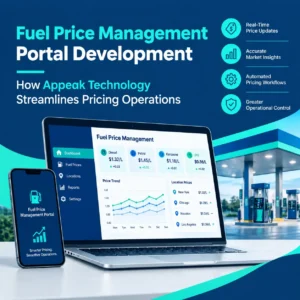
A fuel price management portal is a web-based application designed to help businesses manage fuel pricing information from a centralized platform. Instead of maintaining pricing data across multiple files or systems, authorized users can access relevant information through a structured digital interface.
Depending on business requirements, a portal can support activities such as price creation, price updates, location-based pricing, user management, approval workflows, historical records, and reporting.
The objective is not simply to display fuel prices. A well-designed platform can help organizations establish a more organized process for managing pricing information and coordinating updates between different teams.
Manual fuel price management can create several operational challenges. When teams depend heavily on spreadsheets or email-based communication, maintaining the latest pricing information can become difficult.
Common challenges include:
These challenges can become more noticeable as the number of fuel stations, products, regions, or pricing rules increases.
A centralized portal can address many of these issues by bringing pricing-related activities into one controlled environment.
One of the primary benefits of a digital fuel pricing portal is centralized information management. Authorized users can access pricing data through a single platform rather than searching through different documents and communication channels.
A centralized system can provide a clearer view of current and historical prices. Administrators may also be able to manage pricing according to locations, fuel types, customer groups, or other business-defined categories.
This structure can make pricing operations easier to monitor and can support better coordination between departments.
Accuracy is an important consideration when managing fuel prices. Even a small data-entry error can result in incorrect information being communicated or displayed.
A digital portal can reduce unnecessary manual processes by introducing structured forms, predefined fields, validation rules, and controlled workflows. Depending on the application’s configuration, users can be required to enter specific information before a price update is submitted.
Automated validation can help identify incomplete or inconsistent information before it becomes part of the final pricing data.
Fuel pricing information may need to be managed by different employees with different responsibilities. A pricing manager, administrator, regional employee, or other user may require different levels of access.
Role-based permissions allow businesses to define what different users can view or manage. For example, one user may create a proposed price while another authorized user reviews and approves the change.
Approval workflows can provide an additional layer of control over important pricing updates. They can also make it easier to understand who initiated or approved a particular change.
Historical data can be valuable for businesses that need to review previous pricing decisions or understand changes over time. A well-developed portal can maintain records of previous price updates based on the organization’s requirements.
Historical information can support internal reviews, reporting, operational analysis, and business planning. Instead of manually searching through old spreadsheets, authorized users can access relevant information from the centralized application.
Reporting functionality can make pricing information easier to understand and share. Depending on business requirements, a fuel price management portal can provide dashboards, summaries, filters, downloadable reports, or other analytical features.
Managers can use these capabilities to monitor pricing activities and identify changes across different locations or time periods.
Better visibility can also help teams coordinate pricing-related tasks more efficiently and reduce dependence on manual reporting.
Appeak Technology develops customized software solutions designed around specific business processes and operational requirements. For a fuel price management portal, development can focus on creating a structured platform that brings pricing information, users, workflows, and reporting capabilities together.
The development process can begin with understanding the client’s existing pricing workflow, user roles, data requirements, and operational challenges. These requirements can then be translated into application features and a user-friendly interface.
A customized approach also provides flexibility to integrate additional functionality as business needs evolve.
A fuel pricing platform should be designed with future requirements in mind. As an organization grows, it may need to add new locations, users, fuel categories, pricing rules, integrations, or reporting requirements.
A scalable architecture can make it easier to introduce new capabilities without rebuilding the entire application. Cloud-based deployment, modular development, secure APIs, database optimization, and responsive interfaces are examples of technical considerations that can support future growth.
Pricing information can be commercially important, making appropriate security measures essential. Access controls, authentication, secure data transmission, database protection, activity tracking, and regular maintenance can help protect sensitive business information.
Security requirements should be considered throughout the development lifecycle rather than treated as an afterthought.
Fuel price management involves frequent updates, multiple users, location-based information, and the need for accurate data. A centralized portal can help businesses replace fragmented processes with a more structured digital workflow.
Appeak Technology focuses on developing business-specific software solutions that can help organizations improve operational visibility, simplify workflows, and manage complex information through centralized applications. A carefully designed fuel price management portal can provide a foundation for more organized pricing operations while remaining adaptable to future business requirements.
For companies considering digital transformation in fuel pricing, the right combination of user-friendly design, workflow automation, data management, security, and scalability can create a practical platform that supports everyday operations and long-term growth.